Commerce
 Commerce is an add-on module that can be installed from the
  Plugin module. After the plugin is installed, a new module is added that integrates with Fishbowl Commerce (previously Sellware). The plugin imports orders from Fishbowl Commerce and also sends product and inventory updates back to Fishbowl Commerce’s product list. Upon order fulfillment in Fishbowl, shipment data gets transferred back to the Fishbowl Commerce order so that the data can flow back to the linked shopping cart. The integration with Fishbowl Commerce allows Fishbowl Advanced to connect to many channels, shopping carts, and marketplaces. The information below is specifically for the Commerce plugin in Fishbowl Advanced. Additional documentation for Fishbowl Commerce can be found here.
Install
The documentation on this page is for the most recent version of the Commerce plugin. To get the most recent version, Update Fishbowl.
- In any Fishbowl Client, open the Plugin module, located in the
 Integrations group.
 - Select the
 Commerce plugin and click Install.
 - Completely close all Fishbowl Clients.
- Exit the Fishbowl Server by right-clicking the Fishbowl Server tray icon and selecting Exit.
- After re-opening the Fishbowl Server, the admin user can access the Commerce module from any Fishbowl Client by opening the Integrations group.
- To grant access to additional users, assign the Commerce-View access right to the appropriate groups in the
 User Group module.
Authentication - Connection and Setup
- If you don’t have a Fishbowl Commerce account yet, click here to schedule a demo. You only need to create one account and then additional users can be added within Commerce.
- You will need to create at least one channel in Fishbowl Commerce in order to connect to Fishbowl. Do this by clicking the Add Channel button. We recommend selecting Fishbowl as your Primary channel. You can create more channels later in the Channels module of Commerce.
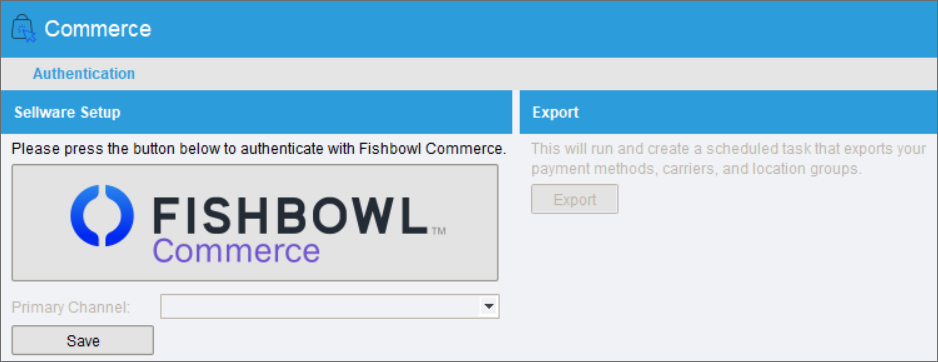
- Once you have a Fishbowl Commerce account and a Primary channel, return to the Fishbowl Client, open the Commerce module, located in the Integrations group, and click the large Fishbowl Commerce button.
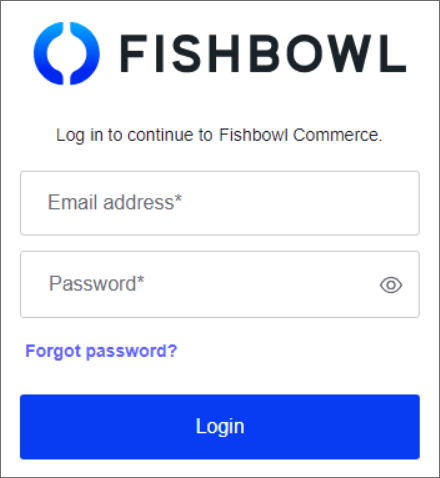
- Enter your credentials and then click Login.
- Select the Primary channel that will be the source of information for your orders, payment methods, location groups, and carriers. We recommend that you select Fishbowl as your Primary channel.
- Click the Save button to complete the connection between Fishbowl and Commerce. The following tabs will appear at the top of the Commerce module:
- Product Import
- Product Export
- Inventory Update
- Order Import
- Fulfillment Export
The tabs listed above are similar to the tabs in Fishbowl's other ecommerce plugins. The difference is that now you don't need a separate plugin for each channel that you use. Fishbowl integrates with Commerce, and then Commerce handles the connections to each of your channels.
- Click the Export button to send Fishbowl's payment methods, carriers, and location groups to Commerce. Similarly, location groups from Commerce will be imported into Fishbowl. A scheduled task is created in in Fishbowl's
 Schedule module to automatically export information every day at 12:00 AM.


TABS
As mentioned above, five tabs appear atop this module after you finish setting up the integration between Fishbowl and Fishbowl Commerce. They are explained in detail below, along with images to guide you through the process of using them.
Product Import

- Schedule - Select the Active checkbox to import products on a set schedule. Click the Run task button to run the scheduled task right now. Data that has changed since the Last Sync date will be synchronized. This date will be updated automatically after a sync, or it can be manually edited to adjust which data will be synchronized.
NOTE: When setting up the Fishbowl Commerce integration for the first time, you will want to adjust the Last Sync to a date before any of your products were created (for example, setting the year to 2000) so that all of the products on your website will be imported.
The Product Import task imports products into Fishbowl from Fishbowl Commerce. A product link is created by storing the Fishbowl Commerce product ID in Fishbowl.
- Link Existing Products will match existing products in Fishbowl and Fishbowl Commerce where data matches in the selected fields.
- Import Products will import products from Fishbowl Commerce into Fishbowl, creating them based on the field mapping and settings below.
Product Export

- Schedule - Select the Active checkbox to export products on a set schedule. Click the Run task button to run the scheduled task right now. Data that has changed since the Last Sync date will be synchronized. This date will be updated automatically after a sync, or it can be manually edited to adjust which data will be synchronized.
- Product Create Settings - Enable Export New Products and then map the fields that should be exported from Fishbowl to Fishbowl Commerce.
- If the Product Tree Filter is used, only the products in the selected product tree category will be exported. If the product tree filter is left blank, all products will be included in the export.
- If the Weight UOM or Size UOM is specified, the Fishbowl product UOMs will be converted to the selected UOMs before the values are exported.
- Product Update Settings - Enable Update Linked Products and then map the fields that should be exported from Fishbowl to Fishbowl Commerce. This section has the same options as the Product Create Settings section above. After the initial product export, only the selected fields will be updated.
Inventory Update

- Schedule - Select the Active checkbox to export inventory levels to Fishbowl Commerce on a set schedule. Click the Run task button to run the scheduled task right now. Data that has changed since the Last Sync date will be synchronized. This date will be updated automatically after a sync, or it can be manually edited to adjust which data will be synchronized.
NOTE: When setting up the Fishbowl Commerce integration for the first time, you will want to adjust the Last Sync to a date before any of your products were created (for example, setting the year to 2000) so that it includes all of your products (or any applicable product tree filter) when updating inventory levels.
- Inventory Type - Select the inventory quantity that should be used during the update: Available For Sale, Inventory On Hand, or Available To Pick:
- Available For Sale - The quantity available is calculated as On Hand - Allocated - Not Available + Drop Ship.
- Inventory On Hand - The total amount of inventory in stock.
- Available To Pick - Calculated as On Hand - Committed for inventory in locations that are marked as Pickable.
- Product Tree Filter - The export can be limited to a specific product tree category. If this field is left blank, all products will be included in the export.
- Specify Min/Max Inventory Quantity - With this option enabled, the maximum inventory quantity sent to Fishbowl Commerce can be limited. For example, if there is an available quantity of 4000 in Fishbowl, the quantity in Fishbowl Commerce could be set to 999. If there is an available quantity of 3 in Fishbowl, the minimum quantity field could be used to send a quantity of 10 to Fishbowl Commerce.
- Include Available-To-Build Quantities - When enabled, this option calculates and includes available-to-build quantities from applicable bills of material in the inventory update. When a product is sold individually but also used as an input for a bill of materials, both quantities are pushed to the channel when applicable. Please note, this could lead to overselling in the scenario described.
Order Import

These settings apply to all ecommerce channels that Fishbowl Commerce connects with. Additional order data will be imported and displayed on the Details tab of the Sales Order module.
- Order field mapping - Use the mapping table to map Fishbowl Commerce order fields to Fishbowl order fields. If no field is mapped to the Fishbowl Order Number, then it will be generated by Fishbowl. If no date field is mapped to the Fishbowl Date Scheduled, then it will be set to the date of import. Click the Add button to the right of the table, and select one of these options from the Commerce Order Field dropdown menu to map to a field in Fishbowl:
- Order ID - A unique numeric identifier for the order in Fishbowl Commerce’s database.
- Marketplace Order # - The shopping cart’s order number.
- Alternate Marketplace Order # - An additional unique identifier from the shopping cart (typically the database identifier).
- Merchant Order # - The Primary Channel’s order identifier, returned upon order acknowledgement.
- Order Date - The month, day, and year that the order was placed in the shopping cart.
- Date Imported into Fishbowl - The month, day, and year that Fishbowl acknowledged and received the order.
- Fishbowl Generated Order Number - The next order number in Fishbowl’s automatically sequenced numbering convention.
- Buyer Email - The email address associated with the shopping cart purchase.
- Referrer - The name of the shopping cart from which the order originated (e.g., Shopify, WooCommerce, etc.).
- Notes - Administrative notes added to the order in Fishbowl Commerce.
- Buyer Notes - Customer-created notes added at the time of order checkout.
- Currency - The currency that the order is billed and paid in from the shopping cart.
- Billing Phone - The phone number associated with the Billing address.
- Shipping Phone - The phone number provided with the Ship-to address.
- Tags - The tag text values imported from the shopping cart (when supported).
- Ship By - The date the marketplace promises that a customer order will be shipped by (when supported).
- Deliver By - The date the marketplace promises that a customer order will be delivered by (when supported).
- Customer Name - The name of the customer who is associated with the shopping cart account placing the order.
- Shipping Name - The name on the Shipping address.
- Shipping Name (Surname-Ordered) - The last name, then first name (separated by a comma) from the Shipping address.
- Shipping Company - The name of the company associated with the Shipping address.
- Billing Name - The name on the Billing address.
- Billing Name (Surname-Ordered) - The last name, then first name (separated by a comma) from the Billing address.
- Billing Company - The name of the company associated with the Billing address.
- Salesperson - Sales orders will be created using this salesperson by default.
- QuickBooks Class - If there is no class mapped from Fishbowl Commerce, sales orders will be created using this class as the sales order class.
- Payment Terms - If there are no payment terms mapped from Fishbowl Commerce, sales orders will be created using these payment terms.
- Shipping Terms - If there are no shipping terms mapped from Fishbowl Commerce, sales orders will be created using these shipping terms.
- Priority - The default priority to be set on imported orders.
- Use customer properties - Pull customer properties to the order such as salesperson, class, payment terms, shipping terms, and priority. If available, these will override the default values selected above.
- Order Number Prefix - Define a short prefix that will be applied to the imported order numbers. The prefix will not be added if the Fishbowl Generated SO Number is being used as the order number.
- Discount Item - Select the flat rate discount type that will be added as a line item to imported orders.
Additional Fishbowl Commerce information
- Import channel discounts as separate line items - Enabling this option will import all line-item discounts separately and apply them to the specific line item they are associated with.
Order Item Settings

- Item field mapping - Use the mapping table to map Fishbowl Commerce order item fields to Fishbowl order item fields. If the Fishbowl price is not mapped, then the price from the Fishbowl product will be used and any applicable pricing rules applied. If the Fishbowl description is not mapped, then the description from the Fishbowl product will be used.
- Shipping Item - Select the shipping type product that will be added as a line item to orders when applicable. It will contain the shipping price to be paid by the customer.
- Ignore shipping amount - Enabling this option may lead to order disparities for totals and payments.
- Ignore miscellaneous items - If this option is selected, Fishbowl Commerce order items that are not related to an actual Fishbowl Commerce product record will be ignored and no Fishbowl line item will be created.
- Enable order import product linking - Fishbowl Commerce order items will be matched to Fishbowl products based on the defined field mapping. If the Fishbowl Commerce product has been linked by ID to a Fishbowl product, that will take precedence.
- Product Field - The Fishbowl product field that will match the selected Fishbowl Commerce item field.
- Commerce Item Field - The Fishbowl Commerce order item field that will match the selected Fishbowl product field.
Order Status Settings

Use the table to assign Fishbowl Commerce order statuses to Fishbowl order statuses. The Order Import task will only import orders from Fishbowl Commerce that are in a status assigned to a Fishbowl order status. If the Fishbowl order status is set to Historical, the order will be imported into Fishbowl, but it will not affect inventory or accounting. At least one active status mapping is required to use the Order Import task.
Location Group Settings

- Use location group override - Select a Default Location Group for imported orders that will override what is provided by Fishbowl Commerce.
- Additional Overrides - Select an option to map to Location Groups in Fishbowl Advanced.
- If the override is not selected, the order will be assigned to the Location Group corresponding to the Fishbowl Commerce warehouse assigned to the first sale item listed on the order. Settings in Fishbowl Commerce allow users to prioritize warehouses on a channel-by-channel basis.
- When the override is selected, the plugin options will determine to which Location Group the order is assigned:
- None - If no additional override options are selected, all orders will be set to the Default Location Group chosen from the dropdown menu. The Additional Overrides option defaults to None, implying the Default Location Group will always be set.
- State - This option allows users to assign Location Groups in the table based on the Ship-to state on the order. For example, an order shipping to Louisiana can be mapped to the Texas (TX) Location Group in order to fulfill orders according to proximity.
- Carrier - This option allows orders with specific shipment carrier services assigned in the table to be routed to Location Groups that specialize in those carriers. Companies with third-party fulfillment centers may find this option useful when those 3PL centers are set up as Location Groups in Fishbowl.
- Tag - This option references the Fishbowl Commerce order tag as an identifying flag. Fishbowl Commerce will bring tags from the Selling channel, Shopify for example, and pass those tags through in the order data. If the tag value is entered as an exact text match of the first tag on the order in Shopify, that tag will determine to which Location Group the order gets set by the mappings in the table.
- Use location group class as order class - This option will set the class for the order to the Location Group’s class.
Customer Settings

Use the options below to determine how customers are created in Fishbowl and what information is imported into Fishbowl.
- Enable multi-currency settings - This option is only available if Currency Conversion is enabled in Fishbowl.
- Enable advanced mapping settings - This option provides additional options for creating and mapping customers.
- Enable wholesale & retail settings - This option modifies the fields below to make the default Customer field and two address checkboxes apply to retail orders and the Field and Alternate Field apply to wholesale customers.
- Use the order customer and addresses - This option will import the addresses and customer from the Fishbowl Commerce order instead of using a generic customer.
- Field - Select the Fishbowl Commerce field you want to use as the Fishbowl customer name.
- Alternate Field - An alternate field mapping when the primary mapping does not contain data.
- Use a default customer for all orders - This option will associate all imported sales orders with the customer selected in the Customer field. This could be used with a generic Fishbowl customer such as Fishbowl Commerce Customer.
- Use order billing address - Use the billing address from the Fishbowl Commerce order instead of the address for the default customer.
- Use order shipping address - Use the shipping address from the Fishbowl Commerce order instead of the address for the default customer.
Address Settings

- Ship-to address mapping - Use the table to choose which Fishbowl Commerce fields are imported into the Fishbowl Ship To Name and Street Line fields.
- Bill-to address mapping - Use the table to choose which Fishbowl Commerce fields are imported into the Fishbowl Bill To Name and Street Line fields.
- Coalesce addresses - If one address is missing, use the existing address for both the shipping and billing address.
- Mark addresses residential - Import all shipping addresses as residential.
Carrier Settings

- Use a default carrier - When selected, orders imported from Fishbowl Commerce without a carrier will use the selected carrier. Please note that this default carrier selection only applies when no other carrier data is available from Fishbowl Commerce. And the Carrier mappings in Fishbowl Commerce will take precedence over this plugin setting when configured. If this option is unchecked, carriers must be mapped in Fishbowl Commerce to avoid order import errors. Additional information is available in this video.
Payment Settings

- Create payments - When selected, payments from each Fishbowl Commerce transaction will be shown in the Payment Viewer module if they are mapped in Fishbowl Commerce.
- Default Payment Method - All orders imported from Fishbowl Commerce will use the selected payment method if payments for them are not mapped in Fishbowl Commerce.
- Always create payments - If no payment data exists for the order from Fishbowl Commerce, this option will always create a payment in Fishbowl equaling the order total. If payment mapping is enabled, orders without payment data will show "None" as the payment method type.
- Remove taxes from payment - When selected, the tax amount will be deducted from the payment total.
- Remove shipping from payment - Enabling this option may lead to order disparities between Fishbowl Commerce and Fishbowl for totals and payments.
- Ignore international payments - Payments will not be created for orders placed outside the United States. This setting is only available if Use Currency Conversion is enabled in the Currency module.
- Currency - Select the currency type you accept in Fishbowl Commerce. This is a required setting if Use Currency Conversion is enabled in the Currency module.
Tax Settings

- Import taxes - When selected, the tax amount from the Fishbowl Commerce order will appear on the Fishbowl sales order as a flat rate line item. The flat rate amount can be set to $0 in the Tax Rate module and then the correct total tax amount will be set when the order is imported from Fishbowl Commerce. If taxes are not imported, the Fishbowl payment will equal the order total before tax.
- Use a default tax item - With this option selected, the same tax item will be used for all orders.
- Use customer default tax - With this option selected, a customer’s tax rate will be used by default on every sales order they are on.
- Use state tax mapping - This option allows different tax items to be used based on the Ship To state/province. If this option is enabled, the plugin will give an error when trying to import an order with a state that has not been mapped.
- Use order tax rate mapping - This option allows you to map tax rates in Fishbowl to tax rates in Fishbowl Commerce.
- Use Fishbowl tax - Select a Fishbowl tax rate that will be used to calculate the order tax in Fishbowl. Tax calculations done by Fishbowl may differ from those done in Fishbowl Commerce.
- Import Commerce tax as line item note - Import the Fishbowl Commerce tax as a line item note in Fishbowl.
Fulfillment Export

- Schedule - Select the Active checkbox to export orders on a set schedule. Click the Run task button to run the scheduled task right now. Data that has changed since the Last Sync date will be synchronized. This date will be updated automatically after a sync, or it can be manually edited to adjust which data will be synchronized.
- The Fulfillment Export task will export order fulfillment information to Fishbowl Commerce based on fulfilled Fishbowl sales orders.
Data mapping
There are five important steps to take to map product and order data between Fishbowl Commerce and Fishbowl.
1. Fishbowl Commerce Product custom fields/metadata
The Commerce plugin has the ability to reference product custom fields from Fishbowl Commerce so that those custom fields can be added to the product mapping tables when importing, exporting, and updating products between Fishbowl and Fishbowl Commerce.
To pull those custom fields into the plugin, use the Custom Fields selection on the Authentication tab referenced in the screen capture below. This opens the Advanced Settings dialog, which manages the accessibility of custom fields from Fishbowl Commerce to Fishbowl. Currently, only Product custom fields are available for mapping.
Next, select the option to Enable Meta Data Mapping in order to access the Pull Meta Data button. After pulling Fishbowl Commerce custom fields, those fields are displayed as available in the table-specific group table to which they correlate. Click Save at the bottom of the dialog. After refreshing the plugin module (by clicking the Refresh button below the Fishbowl menu options), those fields should now appear as mappable fields in the respective mapping tables for which the data corresponds.

2. Shopify Product Tags is one of the metadata fields that can be pulled from Fishbowl Commerce via the custom fields. Currently, Shopify Product Tags is a mappable option in the Product Export tab.

3. Fishbowl now has the option to map Order Tags from Shopify, through Fishbowl Commerce, into Fishbowl. While the data is not visible in the Fishbowl Commerce user interface, the tag data will appear in the field selected in the order mapping table after the mapping has been added and saved. All tags will be listed in the destination field as comma separated values.

4. Fishbowl orders will now honor the Location from the first line item on Fishbowl Commerce orders via the Linked channel order settings. Location settings have been largely removed, but a Location Group override is still in place to set a default location for all orders from Fishbowl Commerce, regardless of selling channel.
a. The Linked channel settings in Fishbowl Commerce allow location priority to be set for incoming orders for that channel.
b. Alternate fulfillment channels from an e-commerce store, such as Amazon FBA, Walmart WFS, and Shopify POS, each have their own location priority settings apart from the main sales channel.

5. Default customers for Fishbowl orders can be set for each channel and alternate fulfillment channel in the Fishbowl Commerce Linked channel settings in the Order Import tab.

6. Order number mapping option and Prefix can be selected for Fishbowl orders via the Fishbowl Commerce Linked channel settings in the Order Import tab.
