Salesforce
 The Salesforce module, located in the
  Integrations group, is an add-on module that can be installed from the
  Plugin module. After installing the plugin, a new module is added that integrates with Salesforce Enterprise or Salesforce Unlimited. Additional connections can also be purchased to connect to multiple Salesforce accounts.
Install
The documentation on this page is for the most recent version of the Salesforce plugin. To get the most recent version, Update Fishbowl.
- In any Fishbowl Client, open the Plugin module, located in the Integrations group.
- Select the
 Salesforce plugin and click Install.
 - Completely close all Fishbowl Clients.
- Exit the Fishbowl Server by right-clicking the Fishbowl Server tray icon and selecting Exit.
- After re-opening the Fishbowl Server, the admin user can access the Salesforce module from any Fishbowl Client by opening the Integrations group.
- To grant access to additional users, assign the Salesforce-View access right to the appropriate groups in the
 User Group module.
Setup
Complete the steps below to configure the Salesforce integration.
- Click the
 Settings button at the top of the module to open the Salesforce Settings window.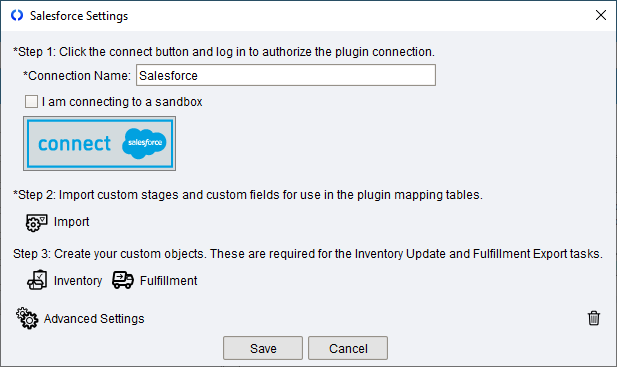
- To connect to your Salesforce account, click the connect button.

- Log in as a Salesforce user with API access.

- Click the Import button to import custom stages and custom fields from Salesforce. These will be used later in the mapping tables.
- Because Salesforce does not have native objects for many of the features available in Fishbowl, Fishbowl can create custom objects in Salesforce. Click the Inventory and Fulfillment buttons to automatically create these objects in Salesforce.
- Review the Advanced Settings and then click the Save button.
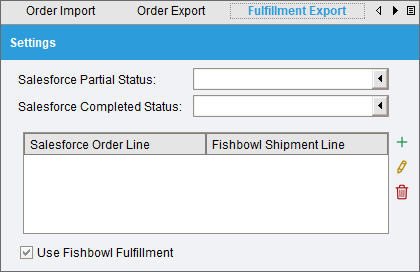
- At the bottom of the Fulfillment Export tab of the plugin, enable Use Fishbowl Fulfillment.
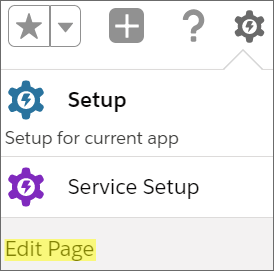
- Open a Salesforce Opportunity in your web browser, click the Settings icon near the top-right corner, and then click Edit Page.
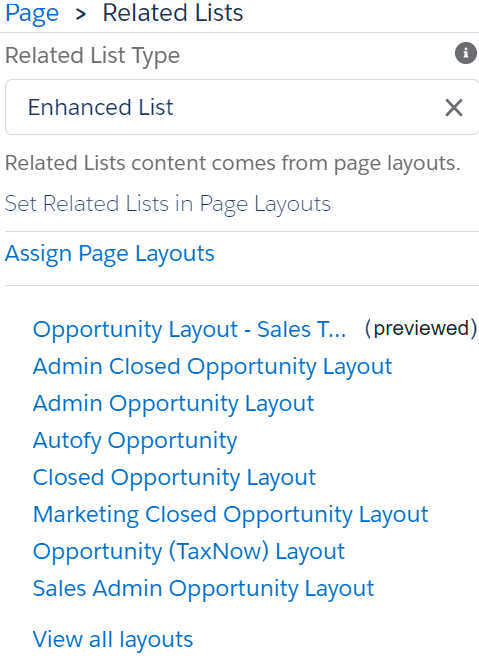
- In the Related Lists section, select the page layout you would like to edit (in this case, the layout marked as "previewed").
- Select Related Lists and then drag Fishbowl Fulfillments to the desired location.
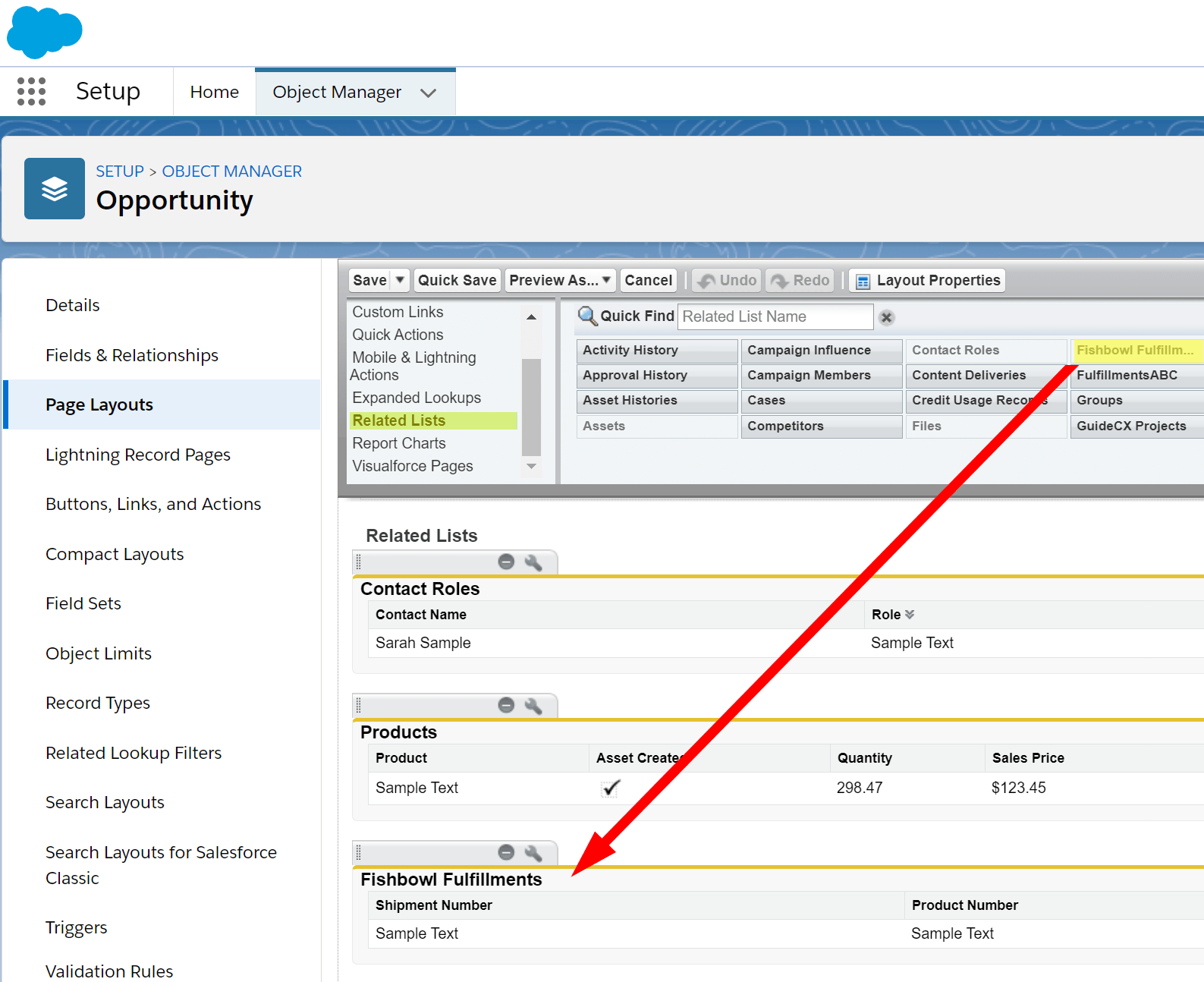
- Click the wrench icon above Fishbowl Fulfillments and choose the fields that you would like to see listed in the Salesforce Opportunity.
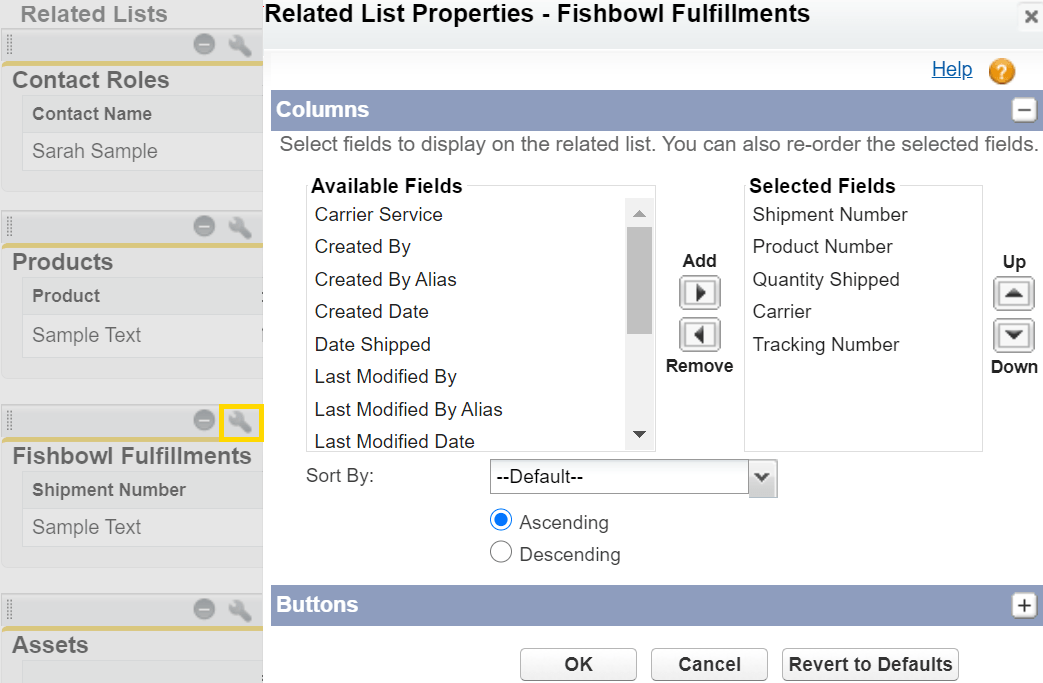
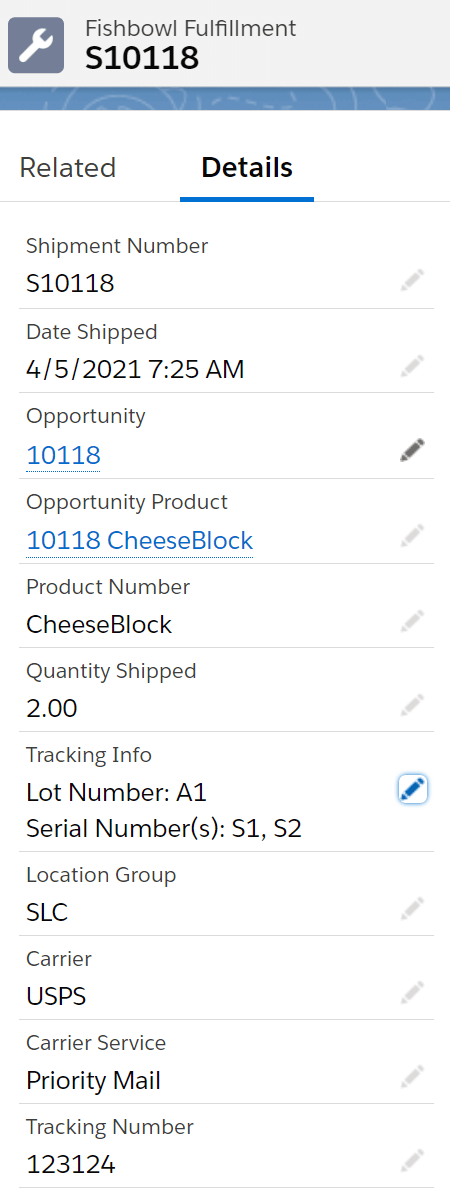
- You should now be able to view the fulfillment information for all future exports from Fishbowl. Each fulfilled item in Fishbowl will have its own fulfillment line on the Opportunity (including multiple records for partial fulfillments).


Object mapping
Object mapping allows custom Salesforce objects to be mapped to Fishbowl as illustrated below.


TABS
Several plugins in Fishbowl have a standardized layout. Some of the images below show the options that are most common between all plugins. Any additional  Salesforce options or notes are included at the bottom of each section.
Order Import

- Schedule - Select the
 Active checkbox to import orders on a set schedule. Click the
  Run task button to run the scheduled task right now. Data that has changed since the Last Sync date will be synchronized. This date will be updated automatically after a sync, or it can be manually edited to adjust which data will be synchronized. If additional options are available, they can be enabled by selecting Use Advanced Options at the bottom of the Schedule section.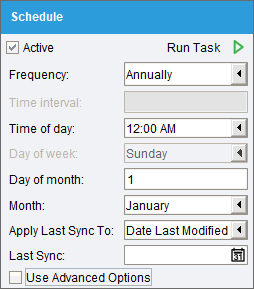


- A Salesforce opportunity must meet the following criteria before it is imported to Fishbowl:
- The opportunity has products that have been linked to Fishbowl through the Product Import or Product Export.
- The opportunity has a billing OR shipping address. If only one address is present in Salesforce, Fishbowl will use that address as the billing AND shipping address.
- The opportunity has a status that is mapped to a Fishbowl order status through the Order Status Mapping.
- Based on Apply Last Sync To setting in the Schedule, the order was created/modified since the last sync date.
Order Settings

Additional order data will be imported and displayed on the Details tab of the  Sales Order module.
- Order field mapping - Use the mapping table to map Salesforce order fields to Fishbowl order fields. If no field is mapped to the Fishbowl Order Number, then it will be generated by Fishbowl. If no date field is mapped to the Fishbowl Date Scheduled, then it will be set to the date of import.
- Salesperson - Sales orders will be created using this salesperson.
- Accounting Class - If there is no class mapped from Salesforce, sales orders will be created using this class as the sales order class.
- Payment Terms - If there are no payment terms mapped from Salesforce, sales orders will be created using this payment term.
- Shipping Terms - If there are no shipping terms mapped from Salesforce, sales orders will be created using these shipping terms.
- Priority - The default priority to be set on imported orders.
- Use customer properties - Pull customer properties to the order such as salesperson, class, payment terms, shipping terms, and priority. If available, these will override the default values selected above.
- Order Number Prefix - Define a short prefix that will be applied to the imported order numbers. The prefix will not be added if the Fishbowl Generated SO Number is being used as the order number.
- Discount Item - Select the flat rate discount type that will be added as a line item to imported orders.
Order Item Settings

- Item field mapping - Use the mapping table to map Salesforce order item fields to Fishbowl order item fields. If the Fishbowl price is not mapped, then the price from the Fishbowl product will be used and any applicable pricing rules applied. If the Fishbowl description is not mapped, then the description from the Fishbowl product will be used.
- Shipping item - Select the shipping type product that will be added as a line item to orders when applicable. It will contain the shipping price to be paid by the customer.
- Ignore miscellaneous items - If this option is selected, Salesforce order items that are not related to an actual Salesforce product record will be ignored and no Fishbowl line item will be created.
- Enable order import product linking - Salesforce order items will be matched to Fishbowl products based on the defined field mapping. If the Salesforce product has been linked by ID to a Fishbowl product, that will take precedence.
- Product field - The Fishbowl product field that will match the selected Salesforce item field.
- Salesforce item field - The Salesforce order item field that will match the selected Fishbowl product field.

Location Group Settings

- Use default location group - Select a default location group for imported orders.
- Use location group mapping - Use the table to map location groups between Salesforce and Fishbowl. This option is only available if Object mapping is enabled.

Order Status Mapping
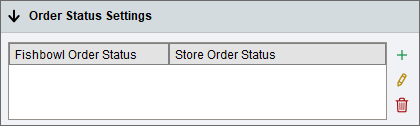
- Use the table to assign Salesforce order statuses to Fishbowl order statuses. The Order Import task will only import orders from Salesforce that are in a status assigned to a Fishbowl order status. If the Fishbowl order status is set to Historical, the order will be imported into Fishbowl, but it will not affect inventory or accounting. At least one active status mapping is required to use the Order Import task.

Customer Settings
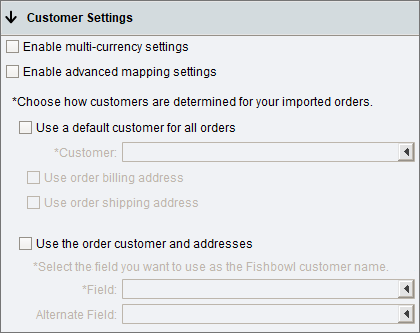
- Use the options below to determine how customers are created in Fishbowl and what information is imported into Fishbowl.
- Enable multi-currency settings - Order prices will be converted from the channel order currency to the Fishbowl currency assigned to the mapped customer. Requires Fishbowl currency conversion to be enabled.
- Enable advanced mapping settings - Opens up additional customer mapping options and control over customer creation.
- Use a default customer for all orders - This option will associate all imported sales orders with the customer selected in the Customer field. This could be used with a generic Fishbowl customer such as Salesforce Customer.
- Use order billing address - Use the billing address from the Salesforce order instead of the address for the default customer.
- Use order shipping address - Use the shipping address from the Salesforce order instead of the address for the default customer.
- Use the order customer and addresses - This option will import the addresses and customer from the Salesforce order instead of using a generic customer.
- Field - Select the Salesforce field that contains the customer name that should be imported into Fishbowl.
- Alternate Field - An alternate field mapping when the primary mapping does not contain data.

Carrier Settings
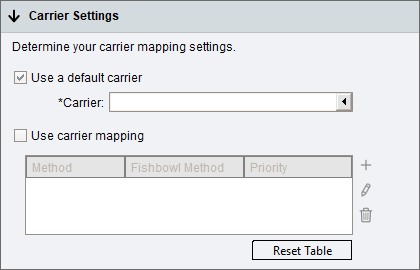
- Use a default carrier - When selected, all orders imported from Salesforce will use the selected carrier. If this option is unchecked, carriers can be mapped between Fishbowl and Salesforce. Each mapping will also set the Sales Order Priority so that Fishbowl users can identify orders with express shipping that need to be picked and shipped quickly.
- Use carrier mapping - When selected, the table can be used to map carriers between Salesforce and Fishbowl.

Payment Settings
-
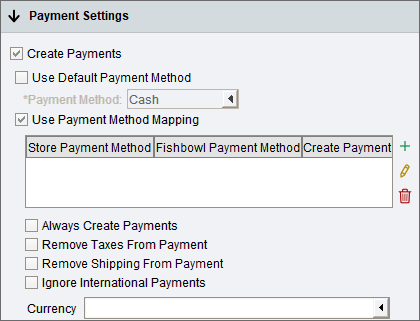
- Create payments in Fishbowl - When selected, payments from the Salesforce transaction will be shown in the
 Payment Viewer module.
- Use a default payment method - When selected, all orders imported from Salesforce will use the selected payment method.
- Use payment method mapping - When selected, the table can be used to map payment methods between Salesforce and Fishbowl.
- Always create payments - If no payment data exists for the order from Salesforce, this option will always create a payment in Fishbowl equaling the order total. If payment mapping is enabled, orders without payment data will show "None" as the payment method type.
- Remove taxes from payment - When selected, the tax amount will be deducted from the payment total.
- Remove shipping from payment - Enabling this option may lead to order disparities between Salesforce and Fishbowl for totals and payments.
- Ignore international payments - Payments will not be created for orders placed outside the United States. This setting is only available if Use Currency Conversion is enabled in the
 Currency module.
 - Currency - Select the currency type you accept in Salesforce. This is a required setting if Use Currency Conversion is enabled in the Currency module.
- See Object mapping for more details.
- Create payments in Fishbowl - When selected, payments from the Salesforce transaction will be shown in the

Tax Settings
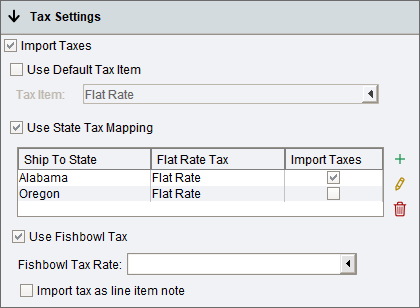
- Import Taxes - When selected, the tax amount from the Salesforce order will appear on the Fishbowl sales order as a flat rate line item. The flat rate amount can be set to $0 in the
 Tax Rate module and then the correct total tax amount will be set when the order is imported from Salesforce. If taxes are not imported, the Fishbowl payment will equal the order total before tax.
- Use Default Tax Item - With this option selected, the same tax item will be used for all orders.
- Use State Tax Mapping - This option allows different tax items to be used based on the Ship To state/province. If this option is enabled, the plugin will give an error when trying to import an order with a state that has not been mapped.
- Use Fishbowl Tax - Select a Fishbowl tax rate that will be used to calculate the order tax in Fishbowl. Tax calculations done by Fishbowl may differ from those done in Salesforce.
- Import Salesforce tax as line item note - Import the Salesforce tax as a line item note in Fishbowl.
- See Object mapping for more details.
- Import Taxes - When selected, the tax amount from the Salesforce order will appear on the Fishbowl sales order as a flat rate line item. The flat rate amount can be set to $0 in the

Order Export

- Schedule - Select the Active checkbox to export orders on a set schedule. Click the Run task button to run the scheduled task right now. Data that has changed since the Last Sync date will be synchronized. This date will be updated automatically after a sync, or it can be manually edited to adjust which data will be synchronized.
- Expand each Settings section to to see the mapping tables. Fishbowl will search Salesforce for the first account name that matches the Fishbowl customer name. If no match is found, an account is created in Salesforce. A Fishbowl order must meet the following criteria before it is exported to Salesforce:
- The order did not originate from Salesforce through the Order Import.
- The order has a status that is mapped to a Salesforce status through the Order Export mapping table.
- Based on the Last Sync Date in the Schedule, the order was created since the last sync date.
- Fishbowl->Salesforce Field Mappings for order export as follows:
- SO number->Opportunity Name
- Customer name->Account Name
- Line item price->Amount
- Product Number->Product Name
- Product Price->Product Price
- Product quantity->Quantity
- Customer Billing address city, state, zip, country->Billing address
- Customer Shipping address city, state, zip, country->Shipping address
- Creation date in FB is sent to the opportunity in Salesforce
Fulfillment Export

- Schedule - Select the Active checkbox to export orders on a set schedule. Click the Run task button to run the scheduled task right now. Data that has changed since the Last Sync date will be synchronized. This date will be updated automatically after a sync, or it can be manually edited to adjust which data will be synchronized.
- The Fulfillment Export task will update Salesforce opportunities based on fulfilled Fishbowl sales orders. A note will be created on the opportunity with the shipment carrier and tracking number. The opportunity status and other fields can also be updated based on how the settings are configured.
- Use Fishbowl Fulfillment will create a fulfillment record on your opportunity for each item that is shipped. To use this feature, you must first complete all of the instructions in the Plugin Settings.
Product Import

- Schedule - Select the Active checkbox to import products on a set schedule. Click the Run task button to run the scheduled task right now. Data that has changed since the Last Sync date will be synchronized. This date will be updated automatically after a sync, or it can be manually edited to adjust which data will be synchronized.
- NOTE: When setting up the Salesforce integration for the first time, you will want to adjust the Last Sync to a date before any of your products were created (for example, setting the year to 2000) so that all of the products on your website will be imported.
The Product Import task imports products into Fishbowl from Salesforce. A product link is created by storing the Salesforce product ID in Fishbowl.
- Link Existing Products will match existing products in Fishbowl and Salesforce where data matches in the selected fields.
- Import Products will import products from Salesforce into Fishbowl, creating them based on the field mapping and settings below.
Product Export

- Schedule - Select the Active checkbox to export products on a set schedule. Click the Run task button to run the scheduled task right now. Data that has changed since the Last Sync date will be synchronized. This date will be updated automatically after a sync, or it can be manually edited to adjust which data will be synchronized.
- Product Create Settings - Enable Export New Products and then map the fields that should be exported from Fishbowl to Salesforce.
- If the Weight UOM or Size UOM are specified, the Fishbowl product UOMs will be converted to the selected UOMs before the values are exported.
- If the Product Tree Filter is used, only the products in the selected product tree category will be exported. If the product tree filter is left blank, all products will be included in the export.
- Product Update Settings - Enable Update Linked Products and then map the fields that should be exported from Fishbowl to Salesforce. This section has the same options as the Product Create Settings section above. After the initial product export, only the selected fields will be updated.
Inventory Update

- Schedule - Select the Active checkbox to export inventory levels to Salesforce on a set schedule. Click the Run task button to run the scheduled task right now. Data that has changed since the Last Sync date will be synchronized. This date will be updated automatically after a sync, or it can be manually edited to adjust which data will be synchronized.
- NOTE: When setting up the Salesforce integration for the first time, you will want to adjust the Last Sync to a date before any of your products were created (for example, setting the year to 2000) so that it includes all of your products (or any applicable product tree filter) when updating inventory levels.
- Export Company Wide Inventory - Include inventory quantities from all location groups in the inventory sync. If this option is unchecked, selected location groups can be added by clicking the
 Add button.
 - Inventory Type - Select the inventory quantity that should be used during the update: Available For Sale, Inventory On Hand, or Available To Pick:
- Available For Sale - The quantity available is calculated as On Hand - Allocated - Not Available + Drop Ship.
- Inventory On Hand - The total amount of inventory in stock.
- Available To Pick - Calculated as On Hand - Committed for inventory in locations that are marked as Pickable.
- Available To Kit - In Fishbowl, kits are comprised of various inventory items, so the kit itself isn't displayed in the
 Inventory module. However, Fishbowl will always export an Available to Kit number to Salesforce. The available quantity exported for kits will be the lowest available quantity for any of the items in the kit. For example, a Wheel kit may require 1 rim and 1 tire. If there are 100 rims available, but only 5 tires, then the quantity exported for the Wheel kit will be 5. The available quantity for a configurable kit will be the lowest available quantity for the default kit items.
- Product Tree Filter - The export can be limited to a specific product tree category. If this field is left blank, all products will be included in the export.
- Specify Min/Max Inventory Quantity - With this option enabled, the maximum inventory quantity sent to Salesforce can be limited. For example, if there is an available quantity of 4000 in Fishbowl, the quantity in Salesforce could be set to 999. If there is an available quantity of 3 in Fishbowl, the minimum quantity field could be used to send a quantity of 10 to Salesforce.
- Include Quantities Available To Build - When enabled, this option calculates and includes available-to-build quantities from applicable bills of materials in the inventory update. When a product is sold individually but also used as an input for a bill of materials, both quantities are pushed to the channel when applicable. Please note, this could lead to overselling in the scenario described.

Customer Import

- The Customer Import task imports customers from Salesforce into Fishbowl. A customer link is created by storing the Salesforce customer ID in Fishbowl. Use these settings to determine how your Fishbowl customers are matched to Salesforce.
- Schedule - Select the Active checkbox to import customers from Salesforce on a set schedule. Click the Run task button to run the scheduled task right now. Data that has changed since the Last Sync date will be synchronized. This date will be updated automatically after a sync, or it can be manually edited to adjust which data will be synchronized.
- Link and update existing customers only - Use this option if the customers already exist in Fishbowl and Salesforce and you just want to link them together or update them.
- Import, link, and update customers - Use this option if you want to import customers from Salesforce into Fishbowl and link them together. If the task is set to run on a schedule, linked customers will be updated and new customers will be imported into Fishbowl.
Customer Export

- The Customer Export task can create and update customers in Salesforce. A customer link is created by storing the Salesforce customer ID in Fishbowl. Use these settings to determine how your Fishbowl customers are mapped to Salesforce.
- Schedule - Select the Active checkbox to export customers to Salesforce on a set schedule. Click the Run task button to run the scheduled task right now. Data that has changed since the Last Sync date will be synchronized. This date will be updated automatically after a sync, or it can be manually edited to adjust which data will be synchronized.
- Update linked customers only - Use this option if your customers are already linked in Fishbowl and Salesforce and you just want to export any changes from Fishbowl to Salesforce.
- Create and update customers - Use this option if you want to export customers from Fishbowl to Salesforce and link them together. If the task is set to run on a schedule, any new customers or changes to existing customers will be exported from Fishbowl to Salesforce.
- Filter by included customer group(s) - This filter can be used to export only the customers that are in the selected customer groups.
Troubleshooting
- Only new orders are imported. Orders are not updated once they have been imported. Returns and refunds are not imported.
- The attributes and IDs for orders and products can be viewed or modified by clicking the
 Salesforce button at the top of the Sales Order module and the
  Product module.
 - To view the scheduled tasks for the Salesforce module, open the
 Schedule module.
 - A scheduled task can be run manually by double-clicking the task.
- Enter an email address in the Schedule module to receive error notifications.
- To view the history of a scheduled task, including the result/error, click the
 History button in the Schedule module.
 - More details about recent errors can be viewed by opening the
 Data module and clicking the
  Server Log button.
 - Check for multiple versions of the Salesforce.jar file in C:\Program Files\Fishbowl\plugins\ or \Applications\Fishbowl\plugins\ on a Mac. If there are two Salesforce versions, exit the Fishbowl Server and remove the older version on all client and server computers.


- Improved error messaging
- Fixed bug with the combine all discounts option not saving the setting correctly in the UI
- Separated order notes and order item notes into separate corresponding fields when orders are imported into FB
- General UI fixes
- Fixed product export tab issue for Canadian users of the plugin
- Fixed null errors on order import
- Added ability to map to custom field/object for billing and shipping address mapping
- Added ability to map to custom field/object for location group and carrier/carrier service mappings
- Fixed bug with payments on order import
- Added ability to pull address from SF account object instead of only the opportunity object
- Fixed bug for kit inventory updates for kits with optional items
- Fixed index 0 size o error on fulfillment export task. This error occurred when a SO has a linked PO with no dropship type SO items
- Fixed bug using the check order status option on the order fulfillment task with completed orders still sending up tracking from FB
- Added ability for users to select which payment method types to create payments in Fishbowl
- Fixed fulfillment bug for orders with only drop-ship items not sending tracking and fulfilling correctly in the channel
- Fixed pricing bug to use the discounted price on order import
- Fixed issue where taxes were removed from the payment amount incorrectly
- Added ability to map custom Salesforce object/opportunity field(s) for payments
- Fixed bug for opportunity owner mapping on order import
- Fixed order item taxable flag so it sets correctly in SF when mapped
- Added ability to map custom Salesforce object/opportunity field(s) for taxes
- Fixed a UI bug in the tax panel
- Fixed mapping bug for opportunity user mapping
**This update will require the user to configure additional settings and mapping tables in the plugin. Contact Fishbowl Plugin Support for assistance**
- General UI Enhancements
- Fixed bug on fulfillment for orders with kits
- Fixed bug where fulfillment export wasn't updating the opportunity status correctly
- Fixed bug where orders with data containing Apostrophes caused the order to error out
- Fixed opportunity queriess so that they only query for the custom SF custom fields that are actually mapped, and not all of the custom fields they have
- This update will cause the scheduled tasks to give an error when first loading Fishbowl after updating. Users will need to go into the plugin interface and configure the additional mappings and save settings in order for the scheduled tasks to run properly
- Added ability to link products on order import. Products that were not previously linked using the product import/export tasks can now be linked during the order import task
- Fixed bug on order import task when creating a new Location Group mapping where the added Salesforce Location would show up blank in the table
- Added enhancement for inventory sync to have a max qty option
- Added enhancement for inventory update to include "Available to Pick" for inventory type as one of the options
- Added enhancement where order import carrier mapping now has a priority option for "All" that doesn't exist in Fishbowl and causes an error when used for an order
- Added enhancement on order settings and on order items field mapping table including custom fields
- Fixed Typo in the payment panel
- Fixed (for supporting channels)where the image export was not working on the product export task
- Misc items are now supported on order import
- Fixed bug with state tax mapping table giving a bad error when a state was not mapped on an order
- Fixed advanced options error message when enabled and a day of the month wasn't specified
- Fixed advanced options error for order fulfillment task'
- Fixed data mapping error with many to one field mappings on product export
- Fixed order import not finding order addresses error
- Fixed inventory sync bug
- Changed error message on order import when products are not linked and the order import failed
- Fixed product import and product export mapping issue which was causing errors and limiting many to one field mappings between FB and the channel
- Fixed invalid status mapping error on order export
- Fixed tax item required bug on order import
- Fixed bug where the SalesForce price book data saved in FB was causing an error when clicking the refresh button in the plugin interface
- On first load, a data migration task will run migrating carrier and payment mapping table data from the previous version
- On first load, existing scheduled tasks will be removed and need to be recreated by Saving the plugin
- Fixed bug where mapping validation error window appeared
- Fixed bug where smaller screens would cut off data in the Plugin UI
- Added UPC field as a mappable product field for product linking task
- Added option to use a tax mapping table on the order import task
- Fixed bug where the fulfillment task wasn't sending up the shipment tracking
- Various AU version fixes
- Fixed bug when customer PO number did not populate correctly when the user did not have "Assign Channel Name order number to Customer PO field" checked
- Fixed bug where order import option to add on order number prefix was not saving
- Fixed bug when QB class setting was not being applied to regular products in orders
- Fixed bug where plugins first loading into a new database displayed pop-up windows that should not be there
- Multi-currency support for orders and payments created from the channel. Multi-Currency must be turned on in FB
- With multi-currency enabled there is an option to not create payments for international orders
- Fixed bug when using the default payment method
- Changed so create taxes option is set by default
- Fixed bug for when discount item field was left blank and saved, causing null errors
- Added tracking to shipments on FB for fulfilled orders
- Fixed bug where UI issue did not allow some order import setting panels to be seen
- Fixed bug where panels were not sizing properly on small screens
**Please note, this update will require you to re-enter the order status mapping table data when first loading the plugin for both order import and order export tasks**
- Added ability to choose whether to sync on hand vs. available to sale inventory quantity
- Improved status mapping error messages during order import using advanced options and the order status hasn't been mapped
- In the order import tab when using the customer matching option, we now provide an alternative mapping option if the first mapping option does not contain data from the cart
- Fixed bug to reenable editing of existing order status mapping
- Updated POS Import customer settings panel to have the same mapping options as the standard order import
- Updated Test Connection success/fail dialog box
- Added a popup window to notify users about status mapping tables being cleared
- On the Inventory Update tab the location group drop down box is now replaced with a checkbox called "Sync all Location Groups"
- When unchecked, a user-defined table gives ability to define which location group(s) will be used to sync to the Channel
- Fixed bug when clicking next button sometimes it would bring the mapping back up that user just created in the order status mapping table
- Fixed bug where lines could be added to order status mapping without data
- Added ability to map the SO contact, phone, and email fields when using the "Use default customer" option on the Order Import task2}}
- Added option to add a custom prefix to the opportunity name on order import
- Fixed bug where the wrong inventory quantity was synced in the following scenario:
- When not using a location group (LG) filter and multiple LG's exist in the FB database and
- When one of the LG's has more inventory allocated than inventory available for all LG's combined
Do not skip this version unless installing the plugin for the first time. If you’re planning to update to a later version of Fishbowl, install 18.10 first, update your plugins, and open them so the data migrator (described below) can run. Then update Fishbowl to the desired version.
- Fixed bug where the inventory object wasn't being created on first install of the plugin in Salesforce
- Fixed bug where inventory updates all linked products instead of the first linked product in the list in FB
- New version number system to match Fishbowl.
- Status mapping table will now display all Salesforce statuses, including custom ones.
- Significantly reduced the number of API calls we’re making.
- Bug Fixes
- Updated for compatibility with Fishbowl version 2018.7
- Newly redesigned with lots of new features
- Ability to export orders to Salesforce to create opportunities
- It's now possible to toggle between your sandbox and live accounts
- Updated for compatibility with Fishbowl version 2018.3
- Fixed a bug to only send "Fulfilled" orders in Fishbowl up to Salesforce
- Fixed validation error against Fishbowl support status when using Salesforce plugin
- Added ability to reset sync date from the plugin
- Fixed inventory sync issue causing quantities to be doubled in Salesforce
- Fixed a product sync bug
- Fixed issue with discounts not calculating correctly
- Fixed tax functionality for Australia and Canada versions of Fishbowl
- Fixed import last sync date using the wrong sync date
- Fixed inventory sync issue when more than 999 in stock, sync would fail
- Fixed authentication error when syncing data