Volusion
 The Volusion module, located in the
  Integrations group, is an add-on module that can be installed from the
  Plugin module. After installing the plugin, a new module is added that integrates with Volusion. The integration requires a Volusion plan with API access (currently Business or Prime plans). Additional connections can also be purchased to connect to multiple Volusion accounts.
Install
The documentation on this page is for the most recent version of the Volusion plugin. To get the most recent version, Update Fishbowl.
- In any Fishbowl Client, open the Plugin module, located in the Integrations group.
- Select the
 Volusion plugin and click Install.
 - Completely close all Fishbowl Clients.
- Exit the Fishbowl Server by right-clicking the Fishbowl Server tray icon and selecting Exit.
- After re-opening the Fishbowl Server, the admin user can access the Volusion module from any Fishbowl Client by opening the Integrations group.
- To grant access to additional users, assign the Volusion-View access right to the appropriate groups in the
 User Group module.
Setup
Complete the steps below to configure the Volusion integration.
- Log into the Volusion store administration page.
- Click the Inventory menu at the top and then select Import/Export.

- Click the Volusion API tab, and then click the Run button next to Generic\Orders.

- Click the Run button at the top of the page.

- Copy the values as shown in the following image.

- Click the
 Settings button on the module toolbar of the Volusion module and paste the Store Url, Username, and Password from the previous step.
- Click the
 Test Connection button, and verify that the connection to the Volusion website is working.
 - Click the Save button at the bottom of the window to save the Volusion settings.


TABS
Several plugins in Fishbowl have a standardized layout. Some of the images below show the options that are most common between all plugins. Any additional  Volusion options or notes are included at the bottom of each section.
Order Import

- Schedule - Select the
 Active checkbox to import orders on a set schedule. Click the
  Run task button to run the scheduled task right now. Data that has changed since the Last Sync date will be synchronized. This date will be updated automatically after a sync, or it can be manually edited to adjust which data will be synchronized.
 - NOTE: To reset the last sync date in Volusion, open a browser, log into your Volusion account, click the Inventory tab, select Volusion API, select RUN next to Generic/Orders, select a date, and then click Reset Export.
- Additional options are available by selecting Use Advanced Options at the bottom of the Schedule section.


Order Settings

Additional order data will be imported and displayed on the Details tab of the  Sales Order module.
- Order field mapping - Use the mapping table to map Volusion order fields to Fishbowl order fields. If no field is mapped to the Fishbowl Order Number, then it will be generated by Fishbowl. If no date field is mapped to the Fishbowl Date Scheduled, then it will be set to the date of import.
- Salesperson - Sales orders will be created using this salesperson.
- Accounting Class - If there is no class mapped from Volusion, sales orders will be created using this class as the sales order class.
- Payment Terms - If there are no payment terms mapped from Volusion, sales orders will be created using this payment term.
- Shipping Terms - If there are no shipping terms mapped from Volusion, sales orders will be created using these shipping terms.
- Priority - The default priority to be set on imported orders.
- Use customer properties - Pull customer properties to the order such as salesperson, class, payment terms, shipping terms, and priority. If available, these will override the default values selected above.
- Order Number Prefix - Define a short prefix that will be applied to the imported order numbers. The prefix will not be added if the Fishbowl Generated SO Number is being used as the order number.
- Discount Item - Select the flat rate discount type that will be added as a line item to imported orders.
 Additional Volusion information
- Combine All Discounts - Enabling this option will sum up all of the line item discounts and apply them as one order discount.
- Add Discount Code To Notes - Enabling this option will add the discount code to the line item notes.
Order Item Settings

- Item field mapping - Use the mapping table to map Volusion order item fields to Fishbowl order item fields. If the Fishbowl price is not mapped, then the price from the Fishbowl product will be used and any applicable pricing rules applied. If the Fishbowl description is not mapped, then the description from the Fishbowl product will be used.
- Shipping item - Select the shipping type product that will be added as a line item to orders when applicable. It will contain the shipping price to be paid by the customer.
- Ignore miscellaneous items - If this option is selected, Volusion order items that are not related to an actual Volusion product record will be ignored and no Fishbowl line item will be created.
- Enable order import product linking - Volusion order items will be matched to Fishbowl products based on the defined field mapping. If the Volusion product has been linked by ID to a Fishbowl product, that will take precedence.
- Product field - The Fishbowl product field that will match the selected Volusion item field.
- Volusion item field - The Volusion order item field that will match the selected Fishbowl product field.
- Additional Volusion information
- Ignore shipping amount - Enabling this option may lead to order disparities for totals and payments.

Order Status Settings
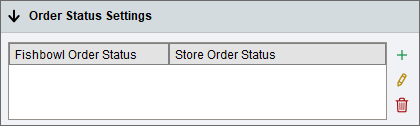
- Use the table to assign Volusion order statuses to Fishbowl order statuses. The Order Import task will only import orders from Volusion that are in a status assigned to a Fishbowl order status. If the Fishbowl order status is set to Historical, the order will be imported into Fishbowl, but it will not affect inventory or accounting. At least one active status mapping is required to use the Order Import task.

Location Group Settings

- Use default location group - Select a default location group for imported orders.
- Use order ship-to state mapping - This option allows orders to be imported into Fishbowl Location Groups according to the ship-to state. If the state is not mapped to a location group, the default location group specified above can be used.
- Use order carrier mapping - This option allows orders to be imported into Fishbowl Location Groups according to the shipping carrier. If the carrier is not mapped to a location group, the default location group specified above can be used.
- Use location group class as order class - This option will set the class for the order to the location group's class.

Customer Settings
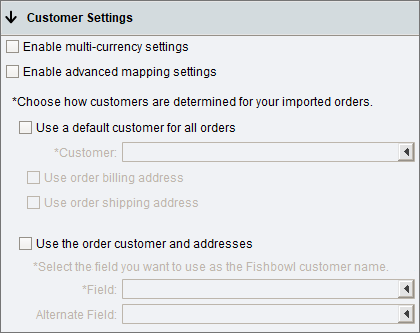
- Use the options below to determine how customers are created in Fishbowl and what information is imported into Fishbowl.
- Enable multi-currency settings - Order prices will be converted from the channel order currency to the Fishbowl currency assigned to the mapped customer. Requires Fishbowl currency conversion to be enabled.
- Enable advanced mapping settings - Opens up additional customer mapping options and control over customer creation.
- Use a default customer for all orders - This option will associate all imported sales orders with the customer selected in the Customer field. This could be used with a generic Fishbowl customer such as Volusion Customer.
- Use order billing address - Use the billing address from the Volusion order instead of the address for the default customer.
- Use order shipping address - Use the shipping address from the Volusion order instead of the address for the default customer.
- Use the order customer and addresses - This option will import the addresses and customer from the Volusion order instead of using a generic customer.
- Field - Select the Volusion field that contains the customer name that should be imported into Fishbowl.
- Alternate Field - An alternate field mapping when the primary mapping does not contain data.

Address Settings

- Ship to address mapping - Use the table to choose which Volusion fields are imported into the Fishbowl Ship To Name and Street Line fields.
- Bill to address mapping - Use the table to choose which Volusion fields are imported into the Fishbowl Bill To Name and Street Line fields.
- Coalesce addresses - If one address is missing, use the existing address for both the shipping and billing address.
- Create missing states - Automatically create missing states.
- Mark addresses residential - Import all shipping addresses as residential.

Carrier Settings
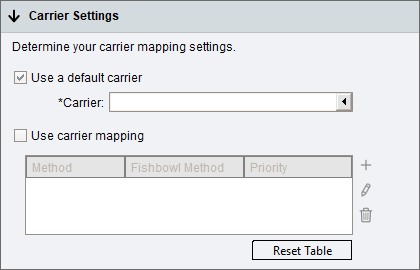
- Use a default carrier - When selected, all orders imported from Volusion will use the selected carrier. If this option is unchecked, carriers can be mapped between Fishbowl and Volusion. Each mapping will also set the Sales Order Priority so that Fishbowl users can identify orders with express shipping that need to be picked and shipped quickly.
- Use carrier mapping - When selected, the table can be used to map carriers between Volusion and Fishbowl.

Payment Settings
-
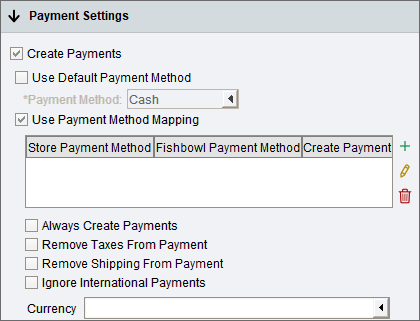
- Create payments in Fishbowl - When selected, payments from the Volusion transaction will be shown in the
 Payment Viewer module.
- Use a default payment method - When selected, all orders imported from Volusion will use the selected payment method.
- Use payment method mapping - When selected, the table can be used to map payment methods between Volusion and Fishbowl.
- Always create payments - If no payment data exists for the order from Volusion, this option will always create a payment in Fishbowl equaling the order total. If payment mapping is enabled, orders without payment data will show "None" as the payment method type.
- Remove taxes from payment - When selected, the tax amount will be deducted from the payment total.
- Remove shipping from payment - Enabling this option may lead to order disparities between Volusion and Fishbowl for totals and payments.
- Ignore international payments - Payments will not be created for orders placed outside the United States. This setting is only available if Use Currency Conversion is enabled in the
 Currency module.
 - Currency - Select the currency type you accept in Volusion. This is a required setting if Use Currency Conversion is enabled in the Currency module.
- Create payments in Fishbowl - When selected, payments from the Volusion transaction will be shown in the

Tax Settings
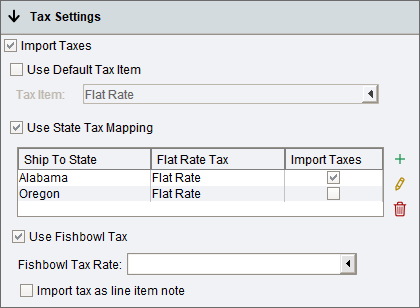
- Import Taxes - When selected, the tax amount from the Volusion order will appear on the Fishbowl sales order as a flat rate line item. The flat rate amount can be set to $0 in the
 Tax Rate module and then the correct total tax amount will be set when the order is imported from Volusion. If taxes are not imported, the Fishbowl payment will equal the order total before tax.
- Use Default Tax Item - With this option selected, the same tax item will be used for all orders.
- Use State Tax Mapping - This option allows different tax items to be used based on the Ship To state/province. If this option is enabled, the plugin will give an error when trying to import an order with a state that has not been mapped.
- Use Fishbowl Tax - Select a Fishbowl tax rate that will be used to calculate the order tax in Fishbowl. Tax calculations done by Fishbowl may differ from those done in Volusion.
- Import Volusion tax as line item note - Import the Volusion tax as a line item note in Fishbowl.
- Import Taxes - When selected, the tax amount from the Volusion order will appear on the Fishbowl sales order as a flat rate line item. The flat rate amount can be set to $0 in the

Canada/Australia/International
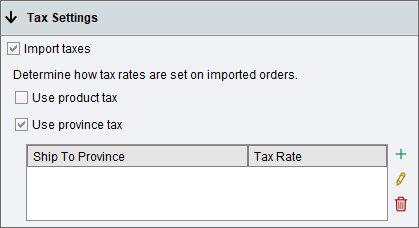
- When using the Volusion plugin with international versions of Fishbowl, some additional tax options are available in the Tax Settings section of the Order Import tab.
- Use product tax - When selected, the Tax Code from the General tab of the
 Product module will be used.
- Use province tax - When selected, the shipping province on the order will be used to determine the tax, based on the mapping table below.
- Use product tax - When selected, the Tax Code from the General tab of the
- When using the Volusion plugin with international versions of Fishbowl, some additional tax options are available in the Tax Settings section of the Order Import tab.


Fulfillment Export

- Schedule - Select the Active checkbox to export orders on a set schedule. Click the Run task button to run the scheduled task right now. Data that has changed since the Last Sync date will be synchronized. This date will be updated automatically after a sync, or it can be manually edited to adjust which data will be synchronized.
- The Fulfillment Export task will export order fulfillment information to Volusion based on fulfilled Fishbowl sales orders.
- Update order status - When selected, Volusion orders will be updated after the product(s) on the order have been shipped in Fishbowl. Shipment tracking information will also be sent from Fishbowl to Volusion.
- Check order status - When selected, the Volusion order status will be checked prior to attempting to send fulfillment information. If the Volusion order status has changed, no fulfillment information will be sent. This will increase the time required to complete the order fulfillment task.
Product Import

- Schedule - Select the Active checkbox to import products on a set schedule. Click the Run task button to run the scheduled task right now. Data that has changed since the Last Sync date will be synchronized. This date will be updated automatically after a sync, or it can be manually edited to adjust which data will be synchronized.
- When setting up the Volusion integration for the first time, you will want to adjust the Last Sync to a date before any of your products were created (for example, setting the year to 2000) so that all of the products on your website will be imported.
- To reset the last sync date in Volusion, open a browser, log in to your Volusion account, click the Inventory tab, select Volusion API, select RUN next to Generic/Products, select a date, and then click Reset Export.
The Product Import task imports products into Fishbowl from Volusion. A product link is created by storing the Volusion product ID in Fishbowl.
- Link Existing Products will match existing products in Fishbowl and Volusion where data matches in the selected fields.
- Import Products will import products from Volusion into Fishbowl, creating them based on the field mapping and settings below.
Product Export

- Schedule - Select the Active checkbox to export products on a set schedule. Click the Run task button to run the scheduled task right now. Data that has changed since the Last Sync date will be synchronized. This date will be updated automatically after a sync, or it can be manually edited to adjust which data will be synchronized.
- Product Create Settings - Enable Export New Products and then map the fields that should be exported from Fishbowl to Volusion.
- If the Weight UOM or Size UOM are specified, the Fishbowl product UOMs will be converted to the selected UOMs before the values are exported.
- If the Product Tree Filter is used, only the products in the selected product tree category will be exported. If the product tree filter is left blank, all products will be included in the export.
- Product Update Settings - Enable Update Linked Products and then map the fields that should be exported from Fishbowl to Volusion. This section has the same options as the Product Create Settings section above. After the initial product export, only the selected fields will be updated.
Inventory Update

- Schedule - Select the Active checkbox to export inventory levels to Volusion on a set schedule. Click the Run task button to run the scheduled task right now. Data that has changed since the Last Sync date will be synchronized. This date will be updated automatically after a sync, or it can be manually edited to adjust which data will be synchronized.
- NOTE: When setting up the Volusion integration for the first time, you will want to adjust the Last Sync to a date before any of your products were created (for example, setting the year to 2000) so that it includes all of your products (or any applicable product tree filter) when updating inventory levels.
- Export Company Wide Inventory - Include inventory quantities from all location groups in the inventory sync. If this option is unchecked, selected location groups can be added by clicking the
 Add button.
 - Inventory Type - Select the inventory quantity that should be used during the update: Available For Sale, Inventory On Hand, or Available To Pick:
- Available For Sale - The quantity available is calculated as On Hand - Allocated - Not Available + Drop Ship.
- Inventory On Hand - The total amount of inventory in stock.
- Available To Pick - Calculated as On Hand - Committed for inventory in locations that are marked as Pickable.
- Available To Kit - In Fishbowl, kits are comprised of various inventory items, so the kit itself isn't displayed in the
 Inventory module. However, Fishbowl will always export an Available to Kit number to Volusion. The available quantity exported for kits will be the lowest available quantity for any of the items in the kit. For example, a Wheel kit may require 1 rim and 1 tire. If there are 100 rims available, but only 5 tires, then the quantity exported for the Wheel kit will be 5. The available quantity for a configurable kit will be the lowest available quantity for the default kit items.
- Product Tree Filter - The export can be limited to a specific product tree category. If this field is left blank, all products will be included in the export.
- Specify Min/Max Inventory Quantity - With this option enabled, the maximum inventory quantity sent to Volusion can be limited. For example, if there is an available quantity of 4000 in Fishbowl, the quantity in Volusion could be set to 999. If there is an available quantity of 3 in Fishbowl, the minimum quantity field could be used to send a quantity of 10 to Volusion.
- Include Quantities Available To Build - When enabled, this option calculates and includes available-to-build quantities from applicable bills of materials in the inventory update. When a product is sold individually but also used as an input for a bill of materials, both quantities are pushed to the channel when applicable. Please note, this could lead to overselling in the scenario described.

Troubleshooting
- Only new orders are imported. Orders are not updated once they have been imported. Returns and refunds are not imported.
- The attributes and IDs for orders and products can be viewed or modified by clicking the Volusion button at the top of the Sales Order module and the Product module.
- To view the scheduled tasks for the Volusion module, open the
 Schedule module.
 - A scheduled task can be run manually by double-clicking the task.
- Enter an email address in the Schedule module to receive error notifications.
- To view the history of a scheduled task, including the result/error, click the
 History button in the Schedule module.
 - More details about recent errors can be viewed by opening the
 Data module and clicking the
  Server Log button.
 - Check for multiple versions of the Volusion.jar file in C:\Program Files\Fishbowl\plugins\ or \Applications\Fishbowl\plugins\ on a Mac. If there are two Volusion versions, exit the Fishbowl Server and remove the older version on all client and server computers.
- If a Volusion export fails, it may be necessary to reset the export to be able to successfully import orders/products. To reset an export, click the Volusion API tab mentioned in step 3 of the setup. Click Run next to the generic export that needs to be reset. Select the date of the export that failed, and then click Reset export.

